
Now, before reading this, I want to clarify that this isn’t part of the blog’s main goals, but I take pride in my bachelor’s thesis, where I achieved a grade of 19/20, losing one point due to a slight inconsistency in my conclusion. Oopsie…
1. Introduction
Christianity has always played a central role in art, shaping aesthetics and symbolism. Most of all, when it comes to the art of the first millennium, Christian themes dominated Western Art. But when we speak of “Christian art’ what exactly do we mean by it? it is very simple; at its core, it is art that depicts sacred narratives, figures or theology from Christianity, most often scenes from the life of Christ or the Old Testament. So, we are mainly speaking of historical depictions and scenes, which one can mainly find in biblical texts. For much of history, such art served two main purposes: to spread the faith (or proselytize) and to glorify the divine. These works operated within what Luhmann calls religion’s “self-referential system,” where sacred symbols communicated transcendence through immanent forms.
Yet, today, the landscape has radically shifted. Far fewer contemporary artists praise God with the help of their art nowadays. Instead, blasphemous or transgressive artworks, that mock, critique, or even repurpose Christian symbols, take the stage and, therefore, provoke heated debates. Why has art ceased to “praise God”? Is it because we already have enough artworks doing so? Have we grown tired of the same sacred themes? Or is it merely a byproduct of what Luhmann describes as “functional differentiation”, a process in which art moves away from being a traditionally religious service, becoming an autonomous system with its own rules? How did blasphemy evolve from a capital crime to an avant-garde aesthetic? And can blasphemy by itself even be considered a legitimate artistic genre?
This thesis interrogates these questions through a multidisciplinary point of view, by merging sociological, theological, historical, and, most importantly, philosophical perspectives. Specifically, it focuses exclusively on Christianity, given its dominant historical and symbolic influence on Western art. I find such an approach necessary, or even crucial, because I doubt that one single discipline can fully explain this phenomenon. The historical aspect, for example, could help us pinpoint when, how, and why religious art declined. Was it due to the Enlightenment’s scepticism, modernism’s rejection of tradition, or simply philosophical nihilism? Niklas Luhmann’s A System’s Theory of Religion, particularly chapters 7 (Evolution der Religion) and 8 (Säkularisierung), will offer us a sociological framework, arguing why there was a collapse of attention in Christianity. These chapters reveal how religion adapts (or fails to adapt) to modernity’s demands, showing how religion’s loss of societal “relevance” (or rather centrality) and authority opens space for new cultural interpretations, such as viewing blasphemy as artistic expression rather than a violation of the sacred. The demotion of religion can reshape how sacred symbols function, or even fail, in art. Theology will clarify certain key definitions and Christian laws, such as the meaning of blasphemy. Finally, by introducing philosophy, we can deepen the critique. Friedrich Nietzsche’s declaration of the “death of God” can also be particularly relevant for this theme as an acceleration of blasphemy’s normalization and observation of transcendence’s collapse into immanence.
Additionally, this research will analyze specific contemporary artworks, which are known for their provocative use of Christian symbolism, such as León Ferrari’s La Civilización y Cristiana, Andres Serrano’s Piss Christ, Chris Ofili’s The Holy Virgin Mary and Maurizio Cattelan’s La Nona Ora to demonstrate how modern art tests religion’s enduring presence in culture. By investigating these examples, I aim to show concretely how blasphemy challenges the sacred and exposes underlying tensions about faith in contemporary society.
Why does this research even matter? It matters because it confronts a paradox: In an era of so-called ‘cancel culture’, where offensive speech is increasingly kept in check, why does blasphemous art continue to thrive? Why is religion frequently “cancelled” while its desecration often seems to be celebrated or at least accepted? And if art is meant to provoke and innovate, why do we still react so strongly to religious transgression? These questions expose our conflicted relationship with the sacred in supposedly secular societies.
This paper will proceed in three main parts. First, I establish blasphemy’s theological meaning and its link to fear. Next, I analyze contemporary artworks accused of blasphemy, examining their intent and public reception. Finally, I will approach the ethical problem by trying to answer the following question: In a pluralistic society, should blasphemous art be tolerated as free expression, or does it cross a moral line? By putting these three facets together, I aim to find out whether blasphemy in art is just a result of religion’s decline or whether it (accidentally) keeps religion alive by making people react. The outrage it provokes might itself already prove that Christianity, though seemingly marginalized, still holds somewhat of an invisible power over our possibly mistaken imagination.
2. Understanding Blasphemy
To begin with, I find it crucial, and also helpful, to clarify the theological meaning of “blasphemy” and how I intend to apply this notion in my thesis. The word “blasphemy” comes from the Greek term βλασφημία (blasphēmía), and originally means “slander” or “speaking ill of someone”. So, in Christianity, blasphemy refers specifically to speech or even actions that show disrespect toward God or even religious beliefs. Blasphemy is explicitly addressed in the Ten Commandments (Decalogue), which is a set of divine laws given by God to Moses on Mount Sinai . Specifically, the commandment prohibiting “taking the lord’s name in vain” directly condemns blasphemous speech and acts, as they dishonour God’s holiness and authority.
However, biblical prohibitions against blasphemy are not limited to the Ten Commandments. Still, they are also stated in other biblical passages, such as in Leviticus 24:16, in which the law declares the severity of blasphemy within the Old Testament context. Not only is blasphemy portrayed as sinful, but those who commit this sin are deserving of the harshest punishment available, death by stoning. So, the severity of this kind of punishment shows the centrality of great respect towards God’s name and authority in the Judeo-Christian tradition.
On top of that, the New Testament continues to put huge importance on blasphemy, where it continues to be a grave offense as the “unforgiven sin”. For instance, in Mark 3:29, Jesus says: “But whoever blasphemes against the Holy Spirit will never be forgiven; they are guilty of eternal sin”. This passage makes it clear that the idea of blasphemy is not only a simple act of verbal offense but is much more profound. It is a spiritual offense, which is capable of causing irreversible damage to one’s connection with God.
In the past, the concept of blasphemy was taken very seriously, unlike today. This pretty much reflects how authoritarian Christianity was within society. Blasphemy was not only seen and treated as a religious offense but also as a political and social offense. Challenging God meant challenging the sacred system. During the Dark Ages, severe punishments—such as public flogging, torture, exile, imprisonment, public beheading, stoning to death, burning at the stake, quartering/dismembering, and so many more barbaric punishments—were very common responses to blasphemous verbalizations or acts. The intensity and severity of those punishments once again prove the Church’s determination to hold its power and control over society. But I also find it important to clarify that from a modern standpoint, those punishments may seem inhuman and irrational, but in actuality, the Church only tried to keep society safe and balanced. Whether those ways were actually reasonable can still be questioned, of course.
One historical example is the European inquisitions, particularly the Spanish Inquisition of the 15th century (1478 – 1834). Blasphemy laws were strictly enforced as an attempt to maintain religious and political order. Reports and accusations of blasphemy and heresy were often made by ordinary individuals, such as neighbors, community members, or, in some cases, even by relatives or friends. Yet, there was also a possibility that in some cases, these accusations were not purely religious but rather encouraged by personal conflicts. The Inquisition encouraged people to denounce any suspicious act, where even a joke, a rumor, or a misunderstood comment could become problematic. This created a climate of fear where one would always have to watch out for what they said.
People were accused of many different things, and among the most common was blasphemous speech, such as insulting Christ, mocking the Virgin Mary, treating sacred rituals with disrespect, and many more. Another common reason for accusation was, of course, heretical beliefs, which meant rejecting or questioning the Catholic set of beliefs. Converts from Judaism or Islam, who were known as Jewish conversos and moriscos (former Muslims who had accepted Christian baptism), were frequent targets, as it was feared that they continued their old faiths in secret (then again, even a simple act like refusing to eat pork could raise suspicion).
Additionally, charges could also include owning prohibited books, or doing witchcraft. What grouped all these accusations was that they were seen as threatening to religious orthodoxy.
Once someone was accused, Inquisitorial agents would begin an investigation by gathering testimony and further information from multiple witnesses about the accused. The accused was unaware of this progress and had no right to defend himself legally or confront the accusers, so trials were held in secrecy. Confessions were a crucial part during the process; either they were direct and admitted their “wrongdoing” or a confession had to be obtained by force through torture or psychological pressure. But then again, even saying nothing could have been seen as guilt, so, most of the time, there was pretty much no way out of this situation. Often, torture was not seen as efficient in the cases of extraction because it was obvious that some subjects would just say what the Agents of the Inquisition wanted to hear to escape the pain7.
So, if found guilty, the punishments were deployed, the leading punishment being more torture. Then there is also public penance, exile, fines, confiscation of property, loss of employment, (lifelong) imprisonment, and in more serious cases, execution. Public humiliation was also a major component of the process. Guilty subjects were forced to wear a san benito, which is a penitential garment used in public ceremonies to shame and correct them . Executions, on the other hand, were rare but still symbolically powerful. Opposed to popular myth, the Inquisition did not execute the majority of the subjects. In fact, only about 2% of those who were brought before the tribunal were actually put to death, which means that fewer than 3 people were executed every year in the Spanish monarchy during the 16th and 17th centuries .
As Europe then transitioned into the Reformation and Enlightenment eras, attitudes and points of view toward blasphemy started changing. Reformers, like Martin Luther, were accused of blasphemy by catholic authorities because they openly questioned the teachings and practices of the Roman Catholic Church, especially practices that Luther believed had no real basis in Scripture. The Roman Catholic Church was the dominant religious authority in Western Europe at the time, so it tried to keep its authority by implementing strict control over doctrine by suppressing disagreeing opinions. In 1517, Luther published his 95 Theses, in which he raised awareness about corrupt practices like the sale of indulgences, which is the idea of paying for the forgiveness of sins. Luther argued that salvation comes through faith alone and that forgiveness can not be bought. So, salvation does not come through money or rituals. The mere fact that Martin Luther decided to go against the Church’s traditions and ideologies not only meant that it was a theological disagreement, but it also meant that it was a political disagreement. By publicly challenging what the church saw as divinely guided teachings and ideologies, Luther was seen as a blasphemer for attacking, so to speak, sacred truth and, most importantly, encouraging others to do the same as him.
However, apart from all the historical context, blasphemy still remains a current topic. But not as extreme as it was in the past. It might have a more emotional charge rather than a political one. So, over time, formal blasphemy laws have been officially abolished in most Western countries, such as in the United Kingdom in 2008. Yet, there are still a few countries with active blasphemy laws and, therefore, also punishments. The punishments range from fines and imprisonment to, in much more extreme cases, even the death penalty. In some countries, the blasphemy laws exist only defacto, which means that while they do not have officially written laws in their legislation, religious offense can still be punished indirectly, either through other laws, which kind of go hand in hand or just do not mention “blasphemy”, or through social pressure.
So, looking at all of this, it becomes clear that throughout history, accusations of blasphemy were often less about actual religious belief and more about control. Blasphemy started as a sin against God, and later became a powerful political tool, used to maintain authority, suppress opposed opinions and therefore, enforce uniformity and obedience. In many cases, it just seems like people were not actually concerned with defending God’s holiness, but rather like they were trying to defend an institutional power. Of course, that is how history tends to be presented in modern media now. But I, personally, still believe that blasphemy mattered and still matters. Perhaps my point of view is somewhat biased as a believer myself. Yet, I do not find that blasphemy should be met with violence, punishment, or forced repentance. Blasphemy, to me, is a personal issue, one that should be dealt with privately and willingly. No one should be forced into salvation or some kind of “correct belief”. If someone is truly ready to reconcile with God or work through doubt, there are gentler and more voluntary ways available, which actually reflect faith and respect. This path can make repentance a lot more meaningful and honest.
And yet, even in today’s secularized societies, in which religion no longer holds the same kind of power it did in the past, blasphemy continues to cause outrage, debate, and strong emotional responses. In the following chapters, this thesis will focus particularly on the tension between the decline of religion’s institutional power and the way people still strongly react when sacred symbols are being provoked. This contradiction raises an important question: if religion is actually losing relevance, then why do sacred symbols still have so much meaning? To explore this, I will draw on Niklas Luhmann’s framework in which he explains how religion evolves and adapts in response to secularization. His framework will help clarify how blasphemy functions as a form of communication, which forces religion to reposition itself. This theoretical approach will then be applied to a few case studies of contemporary artworks, which were accused of blasphemy. Not only will we examine what these artworks are supposed to express, but also how the public responded to them, and what that means for the cultural position of Christianity today.
3. Normalization of Blasphemy
Before diving into concrete examples of Christian Art and Blasphemous Art, this section takes a more foundational role. I believe that a deep engagement with Niklas Luhmann’s A System’s Theory of Religion (Original title: Die Religion der Gesellschaft), which was published in 2000 after his death, will help us get a better insight and understanding of how modern society came to tolerate, aestheticize, and, in some cases, even reward blasphemous expression, especially in the world of art. So, for that, I find Chapter 7 (The Evolution of Religion) and Chapter 8 (Secularization) to be particularly interesting for this thesis. Luhmann presents in his book a framework that goes beyond theology, and helps us understand the structural changes that made blasphemy both thinkable and acceptable in secular culture.
Chapter 7: The Evolution of Religion
Let’s begin by going over the seventh chapter of the book. Luhmann opens this chapter with the statement that, in religion, “[…] there are permanent initiators of variation situated in the difference of familiar/unfamiliar or later in that of “this world/other world” (Chapter 7, page 189). So, religion begins and evolves through a certain distinction or differentiation, which is the distinction between what is accessible and what is not. This is his foundational idea of the distinction between transcendence and immanence, which we will be able to capture in a few case studies in the later section. What Luhmann means with this distinction is that religious communication (Luhmann explains in earlier chapters that Religion is to be seen as a “communication system”) is shaped around translating transcendence, which is the unreachable or the divine, into immanent forms (rituals, texts, images, doctrines). This is how, according to Luhmann, religion functions. The unknowable, intangible and invisible, is made knowable, tangible, and visible.
This can also be applied in Christian terms. One could say that God represents transcendence, while human beings represent immanence. Religious practices, and even religious art, can serve as a bridge between the two. The divine cannot be directly shown or understood, but it can definitely be communicated through symbols (the cross, the dove, the lamb), visual representations (icons, art), or rituals (baptism, the Holy Communion, the act of crossing oneself), which can pretty much be only communicated through materials, and the human being himself. For example, a painting of Christ is made of earthly material (immanence), made by a human being (once again, immanence), but it refers to something sacred and eternal (transcendence). So, this bridge between the transcendent and the immanent is where religious art finds its power and purpose (which pretty much already lays out the main point of the next section).
Luhmann continues to describe how religion has historically evolved from having fixed and stereotyped communication, to being a “functionally differentiated system”, or in other words, a distinct, or separate, system with its own rules and beliefs. In early societies, religion was pretty much present in all areas of life. There was a certain rigidity in how religion appeared in everything, and this rigidity ensured that religion could be easily recognized. This also meant that innovation was limited, if not even completely avoided or stopped. So, as society developed, and therefore became more complex, there were additional distinct functional systems that emerged, for example science, politics, and even art (the way we know it now). Those systems work on their own terms, with their own rules, so religion too had to specialize, since it could no longer claim control over all areas of life. It became just one system among many, which focuses on communicating transcendence and making sense of it.
Luhmann also argues that it was with the introduction of writing that this shift happened. Writing allows one to have a possibility to recognize, and therefore even question things. This is where the dynamics of religious communication started changing. Luhmann writes, “Writing broke with the pre-existing self-stabilization of variation by repressing deviations and changes due to forgetting” (Chapter 7, page 194). Writing gave religion a more stable foundation by putting the teachings into texts, which anyone who could read had access too. So, religion did not have to rely on spoken traditions anymore. But as soon as ideas were written down, people could have all different kinds of interpretations, which often even led to conflict.
Religion did not change on its own. It mostly reacted to changes which were happening in society and adapted to these challenges. And over time, religion just started to detach itself from other areas of life. That is how it became its very own system with its own way of maintaining itself. This self-sustaining structure is what Luhmann calls autopoiesis (he already introduces this term in chapter 1). It is autopoiesis which allows religion to continue to survive in a changing world. However, this also meant that people from inside the religion, such as believers, theologians, or church members, have the possibility to question it from within. They could point out contradictions and discuss interpretations in biblical texts. Over time, these changes, which were internal, so they were not necessarily from outsiders or enemies, made it a lot harder for religion to keep total control over how people lived or thought. There was just no escaping it as it was always inevitable. It was just a matter of time.
So, the loss of religious totality in society is important when it comes to understanding how blasphemy has changed within the time and has even become somewhat “normalized”. In a world where religion no longer sets the rules, its power to identify, and then enforce violations, such as blasphemy, is weakened, if not even completely muted (depending on the country, of course). Religion has become one code among many and the sacred has therefore even become optional.
What used to be seen as a universal offense, can now be interpreted differently depending on the system. What religion might (still) see as deeply offensive, art might see as expressive or thought-provoking. And in some cases, art does not mean to oppose religion, but rather to contribute to it, just like internal members of faith might question or reinterpret certain teachings in order to strengthen or renew them. Of course, there is also art that just explicitly means to attack religion or its teachings. Art can open up space for reflection, new perspective or perhaps even healing. In the next section, I will look at a historical Christian artwork that might be doing exactly that.
Chapter 8: Secularization
In the eighth chapter, Luhmann directly addresses the question of secularization. He immediately denies the belief that secularization simply means the decline or complete disappearance of religion. Instead, he argues, “Secularization is therefore a concept that belongs to a society whose structures suggest polycontextural observation […]” (Chapter 8, page 212). This means that modern society is made up of many systems, and each system observes and interprets differently, as we have already seen in chapter seven.
Luhmann writes, “Functionally speaking, it makes little sense to refer to religion— either economically, politically, and scientifically, or in the family, socialization, education, or medicine” (Chapter 8, page 213). Religion just is not and most probably will not have the main voice in society ever again. It just has its own separate space.
This change has a major impact on how blasphemy is understood. In the past, when religion had total power, blasphemy was simply considered as a serious and punishable crime. But in today’s society, the same blasphemous acts might be interpreted very differently depending on the system.
Luhmann also points out another big transformation. He argues that religion has become a personal matter, rather than a public one. He writes: “Religion, it was said, had thus become a private affair, nothing more than the object of a person’s private sense of well-being. Religion became à la carte” (Chapter 8, page 216). So, faith is now just treated as something individual, and not a universal truth that everyone necessarily must follow. Because of this, blasphemy is no longer judged in a universal or legal sense, at least not in most Western countries.. It might still offend individuals, or religious communities, but it rarely leads to formal punishment or social exclusion, especially when it concerns Christianity. In fact, compared to some other religions, public or legal consequences for Christian-related blasphemy seem much less common today.
Religion tries not to just stay quiet in this increasingly pluralistic society. It attempts to react to the challenges of secularization. Luhmann writes: “Secularization is observed as a provocation to religion, and that is why religion responds to this provocation in several ways—with forms that may be incompatible, culturally acceptable, or perhaps even “strange” (Chapter 8, page 212). In other words, religion tries to adapt as much as possible. It might experiment with new forms of worship, rethink and reinterpret its teachings and/or symbols, and all this just to remain relevant in a world where it is no longer the main authority.
So, blasphemy in modern society can also be something that religion can use as a reason to change, reflect, or even grow. I realize this might sound like I am putting blasphemy in a positive light, which is definitely not my intention, especially as a Christian myself. But remember how we previously mentioned that internal members of religion can now question, reevaluate, and reform things from within? I think art, and even controversial expressions like blasphemy, can sometimes play that role.
Personally, I have to say that I agree with what Luhmann describes in these two chapters, and not only the two chapters, but his whole book. It is not just theory, but I do feel like it is very visible in the way Christianity continues to try and stay relevant today. You can see it in how churches experiment with new forms of worship, which can go as far as the creation of megachurches, which did attract a relatively big amount of followers. From the outside some of these attempts can feel a bit extreme, or even desperate, and I say that as an internal member of Christianity.
At the same time, I have noticed what seems to be an increasing interest in faith among younger generations. There is definitely a spike, maybe some kind of revival. Yet, sometimes it feels less like deep belief and more like a trend, or even an aesthetic. I do not mean this in a judgmental way, as I am part of Generation Z too, and I do not think everyone is just doing it for show. But it is hard not to notice how platforms like Instagram or TikTok shape how religion is seen and shared. In a way, I believe that social media today plays a role similar to what writing once did, it spreads religious content widely, gives it new forms, and also opens it up to more reinterpretation, confusion and critique.
However, along with this “revival”, there also seems to be a noticeable return of a very specific kind of fear, which is a fear tied to the apocalypse. Many believe that we are living in the “end times”, seeing current global events as signs, which were predicted in the Bible, before Christ’s second coming. Images of wars, natural disasters, and moral “decline” are discussed intensely online. This kind of fear perfectly aligns with what Luhmann suggests about how religion processes uncertainty, by giving meaning to overwhelming events.
Was Blasphemy Normalized?
Based on Luhmann’s framework in chapters seven and eight, I believe that the answer is pretty close to being a simple “yes”. Structurally seen, of course. Blasphemy has become normalized, not in a way that everyone agrees with it, but in a way that society now allows it to exist across different contexts. In many western countries, it is now not seen as this universal threat anymore, but rather as something that is open to interpretation.
This normalization was made possible by several developments that are interlinked between one another. First, religion no longer stands as the single dominant authority. Second, religion maintains itself not through external enforcement or collective fear, but through internal consistency. Third, faith is increasingly treated as a private choice rather than an institutional requirement. And finally, the structure of modern society allows different fields to coexist and interpret the same action in radically different ways.
This is why a single artwork can be seen as offensive in one space, and celebrated in another. A blasphemous image might cause anger in a church, but can cause admiration in a museum or art gallery. This is the result of “polycontextularity”, an idea which Luhmann already presents in earlier chapters of his book.
Then there is also the fact that the boundary between immanence (this word) and transcendence (the outer world) has lost its leverage. What was once intangible and inimaginable can now be represented, challenged, or even reimagine.
And this ties back to the role of fear and belief. Luhmann, in earlier chapters of his book, explains how fear, especially the fear of not knowing what comes after death, served as one of the strongest stabilizing forces of religion. Luhmann writes, “One can thus see it as a function of religion to provide comfort, to soothe fears, to answer questions of meaning plausibly, and to generate community by ritual activities or activities confirming faith” (Chapter 3, page 90). So, soothing fear was and is a main function of religion, and it did so by presenting the concept of “heaven and hell” to the anxious. The threat of divine punishment created a structure of meaning and control in behavior. But as this fear, and other fears, such as fearing the almighty God, gradually lost credibility in modern times, so did one of the main methods that had supported religious dominance during the past. One possible explanation for this decline could be the influence of nihilism or existentialism, which may have weakened fear, or even belief in a divine order. I believe that this philosophical shift contributed to this a lot, where fear of the afterlife started to seem less serious. In this context, Friedrich Nietzsche’s famous proclamation of the “death of God” becomes particularly relevant. Not just as a provocative statement (which should not be seen as an argument, but as an observation), but as a reflection of how society started to detach itself from the deeper, spiritual beliefs that used to give life a meaning. Nietzsche believed that without a God, or faith in God, people would lose the clear moral rules and sense of purpose that religion used to provide. He was pointing out a serious consequence. So, when Nietzsche said “God is dead”, he was mostly warning that without that kind of anchor, the world could fall apart. So, if fear once helped to stabilize religious order, then the decline of that fear will naturally contribute to the normalization of what used to be seen as blasphemous.
So yes, structurally, blasphemy has, in my opinion, most definitely been normalized. It has been normalized because it just is no longer seen as universally taboo. Especially in the world of art. There is now so much room for free expression, in a way that blasphemy has become a statement rather than an actual rejection of faith. Art, as one of religion’s competing systems, just interprets the world much more differently. But the fact that religion still continues to react and adapt, and still inspires reflection, is, to me, proof enough that it continues to matter.
4. Christianity in Art
After having analyzed Luhmann’s framework, I want to talk more about Christianity in art. Specifically about the function of such art.
Christian, or sacred, art did not just randomly appear with no specific purpose. For most of history, it served as both visual theology and religious communication. It was mostly created to teach and glorify, and sometimes, it was even made to warn. Especially in earlier centuries, when literacy was not too widespread. So, art was a rather practical and effective way to spread Christian stories and values. Even churches were, and still are, covered with Christian stories, inside and outside: statues, relics, decorative stonework/facade sculptures, walls, and even stained window glass, covered with saints, miracles, judgment scenes, and biblical narratives. This kind of decoration, which is not just decoration but rather a way of communicating with the viewer (or believer), can even be found at the Cathédrale Notre-Dame de Luxembourg.
So, this means that Christian art from the past was not just about aesthetic beauty (though I find Christian art to be particularly beautiful and strong), which makes it even more meaningful (not that art nowadays does not continue to create art with meaning). Christian art was a huge part of society. The Roman Catholic Church was the biggest and most important client (a very valuable and loyal customer indeed), as it commissioned and funded Christian art, but it also supervised the creation of these artworks. The Church held most of the power when it came to the creation, and later also the approval, of Christian art. Artists were often expected or (indirectly) forced to stay within boundaries when it came to iconography. They had to follow a certain list of rules when painting Christ, or Mary, or even a martyr. For example, Christ was usually depicted with specific visual aspects, such as a beard, shoulder-length hair, and always a very calm expression on his face. Wounds had to be in specific and correct places. Even the colors, places, symbols, expressions, instruments of the martyrs’ death, etc. Everything had to be right. Those rules were made to preserve theological accuracy and also meaning. If there was a deviation of an important detail, one could call it a “secular painting”, Simcha Fisher would say.
To make this a bit more concrete, I want to look at three classic examples of sacred art: Caravaggio’s The Conversion of Saint Paul, Michelangelo’s The Creation of Adam, and Leonardo da Vinci’s The Last Supper. These three artworks are not just technically astounding, but they all have some kind of theological message. By looking at these three works, I want to go more into why they were made and who they were made for, and obviously the story they tell. Therefore, I shall not go too deep into the artistic details of the pieces.
Caravaggio’s The Conversion of Saint Paul, or The Conversion of Saul (1600 – 1601):
This painting is one piece of a pair of paintings created as side panels. It accompanied another painting of Caravaggio’s called The Crucifixion of Saint Peter (1601). The two paintings were commissioned to be painted on cypress wood by the Capella Cerasi. Although the original patron declined the works because he surprisingly disliked the composition, the works were then kept by Giacomo Sannesi.
In this version (Caravaggio created another version only a few months later), Saint Paul, but then still known as Saul, lies on the ground, shielding his eyes with both hands from a blinding divine light that pours toward the floor. From the upper right corner, Christ, accompanied by an angel, extends his arms open towards him. The physical presence of Christ disrupts the boundaries between the earthly and divine, as Sebastian Schütze explained. It can even be compared to Luhmann’s concept of immanence and transcendence, which we have seen in the previous section.
This painting is very dramatic, not only because of the strong contrast, lighting, and expressions, but also because it shows a very big moment of a rather radical transformation. Saul, who was a persecutor of Christians, is met with an overwhelming divine intervention. This is the beginning of his conversion and his journey to becoming Saint Paul. Caravaggio’s intention was to really show the force of this divine intervention through this very powerful painting. So, the viewer is not only made familiar with a biblical story, but they are also being pulled into the painting’s darkness. In that way, this example of Caravaggio’s many biblical paintings (all as powerful as this one) reflects exactly what Christian art is supposed to do: communicate a religious story in a way that completely moves and shakes you. Perhaps it can even lead to your own conversion…
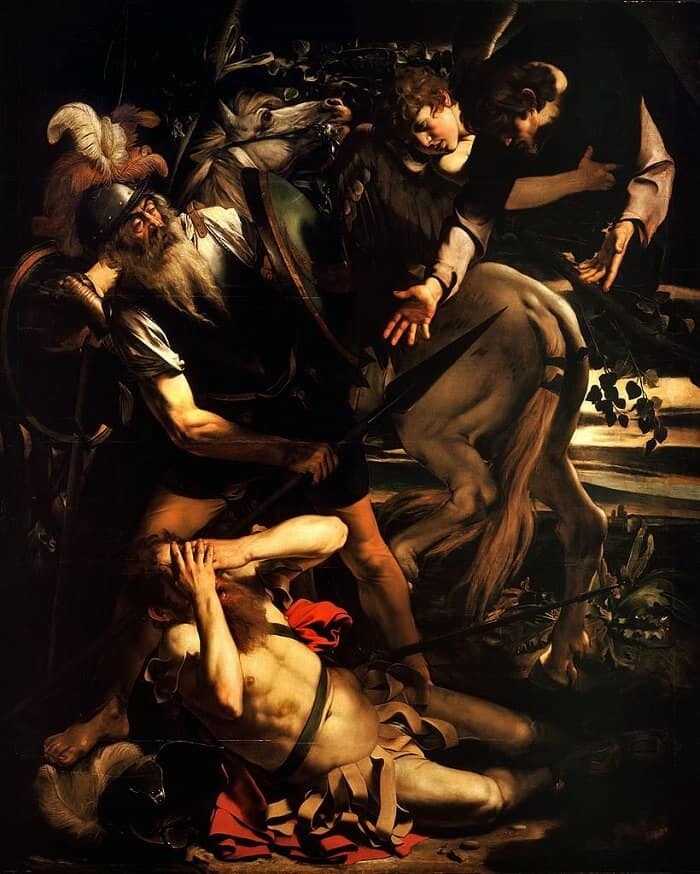
Caravaggio, The Conversion of Saint Paul (1600-1601)
Michelangelo’s The Creation of Adam (1508 – 1512):
This artwork is one of the most recognized parts of the Sistine Chapel’s ceiling. This fresco is only a small part of a very large project that covers over 500 square meters. It was painted by Michelangelo under the patronage of Pope Julius II, despite Michelangelo’s reluctance at the beginning, as he considered himself more of a sculptor than a painter. Interestingly enough, he was originally asked to paint only twelve apostles, but the final design kept increasing in size, and he ended up including over 350 different figures.
The Creation of Adam itself is placed right next to The Creation of Eve, which is placed in the centre of the Sistine Chapel’s ceiling. So, it is pretty much a central point of the biblical texts, as it marks the beginning of life. Specifically, it goes back to Genesis, in which God gives life to the first human.
In this artwork too, immanence and transcendence become a major subject. The nearly touching fingers of God and Adam can be seen as visual metaphors for divine-human connection. This, and, of course, the fact that the ceiling is just overwhelmingly impressive, could inspire the visitors of the chapel to take the path to Christianity, and form a connection to God. A very straight forward message, in a way!
In Michelangelo’s work, God is also surrounded by what seems like a reddish cloak. This cloak has already had many different interpretations. The cloak could represent a human womb, linking the origins of life to divinity. However, it could also just simply represent the mist, or dust, rising from the earth, which was mentioned in Genesis. Michelangelo captures this transformation visually by portraying Adam as grounded, while God floats before him. As for God’s finger reaching out towards Adam, Ascanio Condivi suggested that it could be interpreted as God “transferring” divine precepts over to Adam.
What makes this work particularly impactful is not just Michelangelo’s way of encapsulating theological symbolism into it, but also the deep emotions, which might be powerful enough for the viewer to feel the urge to long for a meaning, and most of all for God. One must just imagine how incredibly enormous the artwork on the ceiling must be when physically standing under, looking up to it, just like Adam looked up to God.
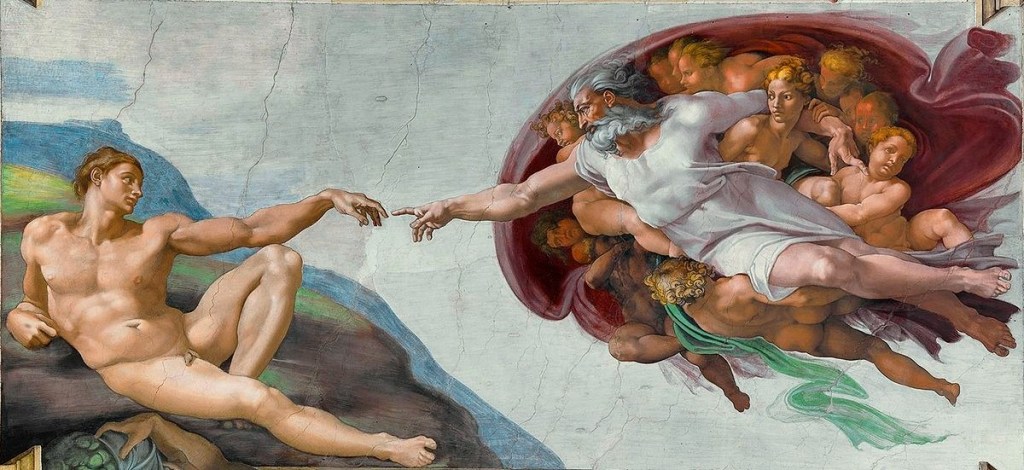
Michelangelo, The Creation of Adam (1508-1512)
Leonardo Da Vinci’s The Last Supper (1495 – 1498):
Finally, one of my most preferred and perhaps even the most iconic religious artworks ever created. I find this piece to be particularly raw, in a way that the response of the apostles to Jesus’ announcement of betrayal seems so familiar. Why do I say “familiar”? Because everyone makes mistakes, and therefore, everyone sins. I feel like this piece brings you closer to Christ, the apostles, and definitely the sacred scene itself. I mean, in order to understand what this painting is about, you would have to at least have some slight knowledge about the biblical event. Nowadays, though, it is made easy by museums, and definitely the internet, to have simple descriptions of the scenes.
This piece was commissioned by Ludovico Sforza, who was the Duke of Milan from 1494 to 1499. Here, Da Vinci decides to really go into detail when it comes to illustrating the event, and he does so by focusing on the apostles’ facial expressions and gestures, which show disbelief, disappointment, confusion, sorrow, and even anger. There is so much going on around Jesus, who is the only figure in this painting who remains calm, almost eerily still. The table stretches straight across the canvas, which draws our glance into the tension, nearly as if we were part of the chaos. And once again, like the two previous pieces we have seen, this piece also does not just show biblical texts in the form of an image. It shows us something extremely emotional and entirely relatable. I like to interpret this in a way that we humans (immanence) do not understand many things, which to God, or the divine (transcendence), just seems so normal, nearly as if it were expected. And there is absolutely no disappointment involved. Only understanding!
But there is still more to say about this piece, making it more interesting. There is the obvious biblical scene, which we can see with our bare eyes. But then I stumbled upon a very interesting theory by a writer and researcher, Hayward Gladwin. He argues that The Last Supper contains more than just narrative. It might actually be built on sacred geometry. Keep in mind that I am no expert in any kind of geometric symbolism! I just find this to be a rather interesting and novel perspective. In his article, Gladwin suggests that Da Vinci used a hidden “dodecahedron”, which is a geometric solid with twelve flat faces. This would seem suitable for this piece, since there are twelve apostles, who are often associated with the divine. According to Gladwin, the vanishing point of the painting, which is believed to be Christ’s right eye, radiates outward in a pattern that closely resembles the angles of a dodecahedron. What is even more fascinating is that the gestures of the apostles and placement of their arms and hands seem to “acknowledge” the invisible geometric shape.
I do not want to dive too deep into speculative theories, since there are just so many of them, but I do find it extremely compelling that a religious artwork could also be mathematical in nature.
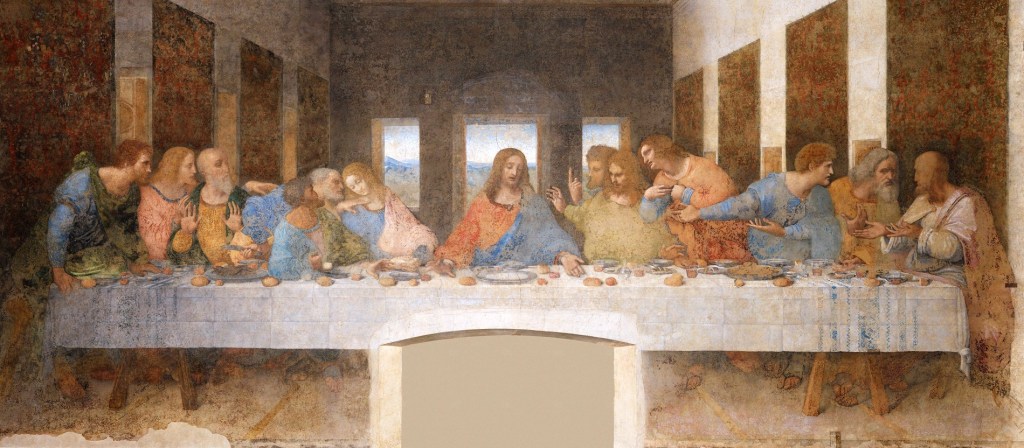
Leonardo Da Vinci, The Last Supper (1495-1498)
All these works show us different biblical events and also different dimensions of Christian Art. They have an emotional impact, whether it is because of the size, the themes, or the specific biblical events. All these three pieces even have an ability to reflect both the divine (transcendence) and the human (immanence). They were also all commissioned by a certain patron, who had some kind of political or religious power. Were it not for them, the whole world would most probably not be able to enjoy the beauty and emotional impact of those now popular pieces. However, the most important part is that religion is not just a simple theme or subject in art, but something that is supposed to shape people in their way of living, thinking, and believing (whether it was intentional, or not).
Today, on the other hand, things look very different when it comes to sacred art. While Christian themes still exist in art, they no longer dominate the way they once did. There are, of course, still artists creating explicitly Christian works, but they rarely receive the same kind of institutional attention as the artists we have seen previously. Religious art has moved from the center of attention to the margins, which in this context could even be social media. Perhaps this is due to the fact that we live in a secularized society or even a pluralistic society, in which no single worldview or religion can truly dominate the cultural space. Or, perhaps it is even because of the fact that modern art focuses more on personal expression, rather than a shared expression, such as that of a shared doctrine. Or, there might be an even simpler option… There is so much art being produced now that we lose track. So, it is honestly just hard to say.
What I do notice, though, is that Christian art today often lives through individual creators, many of whom share their work online. It can be on popular social media platforms like Instagram or TikTok, such as mentioned earlier. You can find everything from digital icons to abstract depictions of biblical stories, which even Simcha Fisher pointed out in their article12. Even contemporary artists who resist traditional guidelines, which we have mentioned earlier in this section, often still engage deeply with sacred themes. So, the rules may no longer apply, perhaps due to the fact that there is no longer an institution enforcing those rules.
So, yes, Christian art is still alive. But it is living in a different kind of life now, which is less institutional, and more personal. It might be even less public, and more scattered, which could be due to the fact that there is a lot of judgment by the public, even in the shape of “hate comments”. And maybe that is fitting for the time we are in. The role of Christianity in art has changed, but the instinct to create from true faith has not gone anywhere.
As a transition to the next section, I want to present another example of Christian art, which is worth pausing on (and I promise this is the last example in this section). The piece is Hans Holbein the Younger’s The Body of the Dead Christ in the Tomb, or just Dead Christ (1521). This painting is haunting, in a way that even Fyodor Dostoevsky was shaken by it. There is no aesthetic aspect to this piece. What is so unusual about this painting is that Jesus is depicted in a mortal demeanour, which is so uncommon for him since it is believed that he resurrected. So, unlike the idealized or glorified depictions of Christ that were common in the sacred art of that time, Holbein decided to show the viewers something raw, almost brutal. Jesus’ dead, decaying body, which is stretched out in a rather claustrophobic, coffin-like box (did I fail to mention that the body of Christ in this piece is life-sized?). The wounds are exposed, the skin is pale, and the eyes are lifeless. This is where I believe that transcendence climbs down to immanence.
What makes this work so interesting is that it is still undeniably Christian art, but it does not have a comforting effect. It is unsettling. Dostoevsky has a character in his novel The Idiot, who is supposed to represent himself as he saw Holbein’s piece. He has that character describe the painting by saying, “At that picture! Why, that picture might make some people lose their faith”. This line alone captures how art can not only reaffirm belief, but it can also make someone reject it. Art, even if it is Christian art, can challenge belief, whether it is intentional or not. I suppose one could even say that this specific sacred piece was testing the limits. And perhaps this makes this piece a potential, yet accidental, blasphemous piece. And with this I want to move forward to the next section.
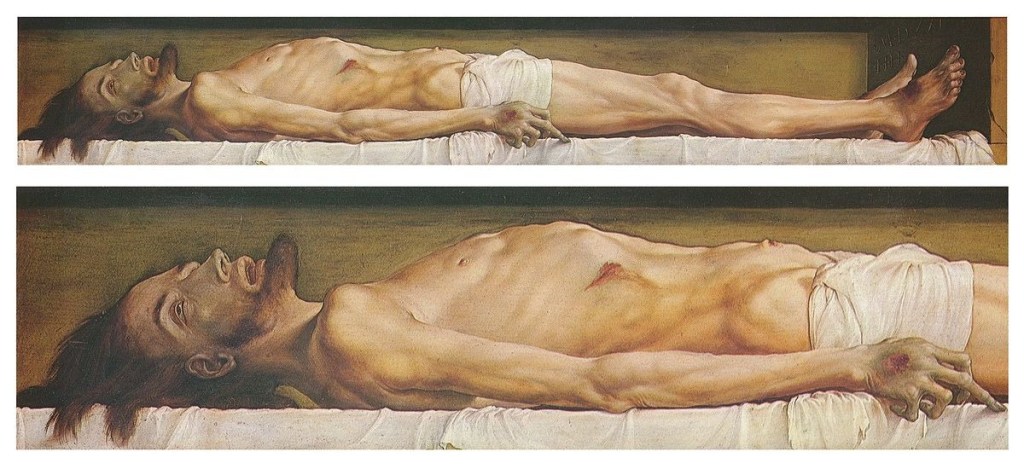
Hans Holbein the Younger, The Body of the Dead Christ in the Tomb (1522)
5. Blasphemy in Contemporary Art
After having already explored Holbein’s The Body of the Dead Christ in the Tomb and how its raw and human depiction can be seen as pushing the boundaries of religious art, this section now turns to pieces that are, somewhat by definition and reception, explicitly blasphemous. These pieces do not only provoke the sacred, but they also scandalize and stir pretty intense political, and also emotional, reactions. Yet, they are exhibited, celebrated and even awarded.
For clarity, this section will consider artworks created from the post-World War II period onward, giving us a working definition of “contemporary art”. Additionally, we will go through the selected case studies chronologically, beginning with the 1960s and moving up to 2024. This approach will allow us to trace the attitudes toward blasphemy across time.
Before we get into case studies of contemporary art that have a blasphemous aspect to them, I want to point out that even some of the most iconic artists of Christian art history were faced with accusations of blasphemy. Michelangelo’s Last Judgment in the Sistine Chapel was condemned by Biagio de Cesena for its nude figures, which were deemed inappropriate, or even “disgraceful” for a sacred space. Cravaggio’s The Death of the Virgin was also criticized because he allegedly used a drowned woman as a model for the Virgin Mary, which was considered disrespectful and even shocking. These examples show that even artists who were clearly known for depicting Christian themes, and had no intention to create a piece that would be seen as strictly blasphemous were still vulnerable to accusations of blasphemy. And this just goes to show how much the point of view matters. Sometimes it just is not the artwork itself that is the problem, but how it is perceived, and how extreme the reaction can become. One person’s anger can lead to collective anger, which is not any different from today’s “cancel culture” (which we will dive into more deeply in the ethics section).
León Ferrari’s La Civilización Occidental y Cristiana (1965):
Let’s start with León Ferrari’s piece, which is powerful, yet provocative. The title translates to “Western and Christian Civilization”. The piece was created in 1965 during the Vietnam War, and it features a life-sized figure of Christ, crucified on top of an American fighter jet. This piece combines both religious symbolism and political critique, so it is mostly considered a protest piece. Ferrari’s motivation behind this piece came from his worries about the moral contradictions he saw in society, especially within the association between religion and state violence. This can even go back to what we have seen in the Blasphemy chapter. He believed that Christianity (especially Catholicism in Latin America) was being used to justify or cover up the violence of oppressive regimes. This issue can also be compared to the current Israel-Palestine conflict, although the context is quite different. The Israel-Palestine conflict involves multiple religions and very complex historical, political, and territorial disputes. Still, in both cases, religion and violence become entangled, which can definitely raise questions about the role of faith in justifying or challenging systems of power.
So, Ferrari used art as a platform for a kind of resistance. He did not see his own work as an attack on faith itself, but rather on the misuse of religion to justify war, torture, and inequality.
His work created major backlash in his home country of Argentina, in Buenos Aires, more specifically. Jorge Mario Bergoglio, now known as Pope Francis, publicly criticized this piece in 2004 by calling it blasphemous and shameful. Therefore, the sculpture was removed from an exhibition in Buenos Aires due to feeling pressure from religious authorities and potentially offending Argentine catholics.
What makes this piece so particularly relevant here is the way the idea of blasphemy goes beyond offensive imagery. Ferrari forces the viewers to think about the conflict between what religion says it stands for, such as peace, compassion, and justice, and what political systems actually decide to do. So, the ideals of Christianity, like “thou shalt love thy neighbour as thyself”, forgiveness, or humility, are often used in political rhetoric, but those same political actors may then proceed to support wars, inequality, or authoritarian regimes. This conflict between Christian ideals and political action is not limited only to past regimes. In recent years, figures like Donald Trump have prominently used Christian rhetoric in their political messaging. Yet, critics have pointed out contradictions between such messaging and certain policies. Whether one sees this as strategic politics, sincere beliefs, or perhaps even a mix of both, it really shows how religion can be drawn into political narratives in ways that may conflict with its original teachings.
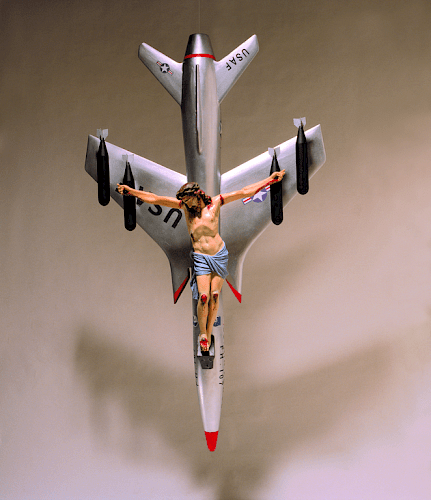
León Ferrari, La Civilización Occidental y Cristiana (1965)
Andres Serrano’s Immersion (Piss Christ) (1987):
Andres Serrano’s piece might be one of the most famous cases of blasphemy in art. This piece is a photograph of a small plastic crucifix submerged in a glass container filled with the artist’s own urine. Visually, the image is pretty impressive, and the urine gives the photo a golden and almost ethereal glow, which, at the same time, contrasts with the deeply offensive nature of the materials used. Serrano’s work was not just exhibited, but it was also awarded the Visual Arts Award from the Southeastern Center for Contemporary Art. The fact that he got awarded for this piece was already reason enough to start an explosive and extreme reaction by the public. Even conservative U.S. senator Jesse Helms claimed that the artist Andres Serrano is a “jerk” and publicly criticized the work for being an insult to Christianity.
I think it is pretty clear as to why Piss Christ is considered blasphemous. Immersing a crucifix in urine is seen as a direct profanity of a holy symbol. Yet, Serrano himself has said that he was raised a Catholic and still is a Christian. He even claims that he has “no sympathy for blasphemy”. His work is not meant to mock Christ but to critique the commercialization of religious icons. So, this is where an interesting question can be raised: Is it still blasphemy if the intention is not to mock or to offend, but to defend the sacred in a provocative way?
In 2011, during an exhibition in France, Piss Christ was physically attacked by a group of four young individuals. They slashed the photograph with a hammer and sharp objects. And this followed weeks of protests and online petitions. People were actively trying to get this piece taken off the exhibition. Even the gallery staff received hate messages and threats, so it was not only directed at the artist himself.
This is where Luhmann’s concept of functional differentiation becomes useful again. Religion and art operate as different systems, each with its own logic and ideologies. What religion may see as a violation, art may view as expressive or critical. And Piss Christ lives in that gap. It offends religious codes, but is understood within the art community as critical.
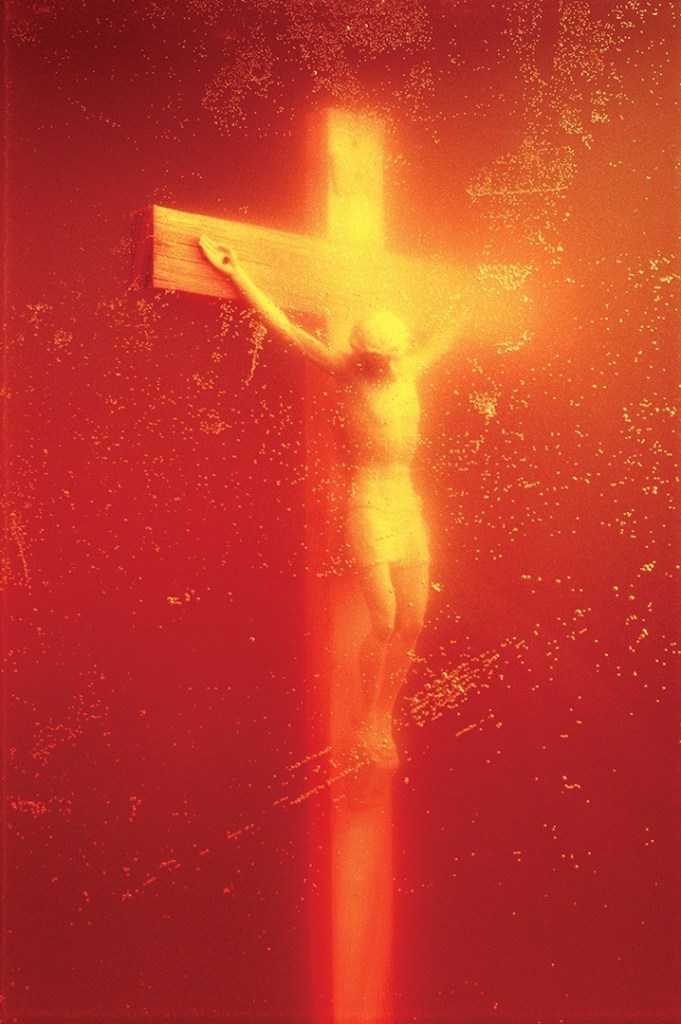
Andres Serrano, Immersion (Piss Christ) (1987)
Chris Ofili’s The Holy Virgin Mary (1996):
Chris Ofili’s The Holy Virgin Mary is another piece known for its controversial nature. It was exhibited in 1999 at the Brooklyn Museum as part of the “Sensation” art exhibition and immediately created an angry reaction by the public. The painting shows a Black Madonna surrounded by cut-outs of female genitalia taken from pornographic magazines. A clump of elephant dung (elephant waste) is placed on one of her breasts, while more dung is used as a pedestal beneath the canvas, labelled with the words “Virgin” and “Mary”.
Mayor Rudy Giuliani condemned the work by threatening to pull public funding from the museum and sue its board of directors. John Cardinal O’Connor called it “an attack on religion” itself. But Ofili, in an interview, stated that the outrage was actually urged by personal misinterpretation. “I don’t feel as though I have to defend it. The people who are attacking this painting are attacking their own interpretation, not mine. You never know what’s going to offend people, and I don’t feel it is my place to say any more”, he said. And I personally really appreciate what Ofili said here, because it fits with what Luhmann explains about how different systems, or in this case, different perspectives, interpret the same thing in totally different ways. Offense is not always about what is actually there, but more about what someone sees in it. And this is exactly what Luhmann’s theory helps us understand. Meaning is always created within a system. I would even go as far as to call it “objectively subjective”, especially when we are talking about reactions shared by a whole group, like Christians, who view the sacred through a specific point of view.
And yet, The Holy Virgin Mary is not just an empty provocation without deeper meaning. It actually reflects on identity, colonial history, spirituality, and race. The elephant dung and pornographic magazine cutouts deliberately push the viewer out of their comfort zone. They are forced to question their views on cultural norms. When we see something sacred like the Virgin Mary, combined with something that is usually seen as dirty and inappropriate, like dung or sexual imagery, we are instantly forced to reflect. Not just on the artwork itself, but on our assumptions. Why exactly do we find this so offensive? Why do these elements feel wrong to us in this specific context?
Here we could go back to what we have discussed in the blasphemy section. There were these specific rules for how Mary was traditionally depicted: white skin, blue robe, gentle gaze, modest posture, covered hair, and, of course, covered body. Ofili chooses to break these rules just to ask why this is the only version we are allowed to see. Historically non-white bodies were excluded from sacred representation. This piece really challenges the viewers to think about what we are really worshipping: the figure of Mary, or the idealized, untouchable image we have constructed of her. So, Ofili kind of forces us to confront those cultural norms that we have internalized. Especially when it comes to race, gender, purity, and sacredness. The discomfort does not (only) come from the materiality of the piece, but rather from our expectations we have before we come into contact with it. Those expectations are then completely shattered. And it is this discomfort that opens up enough space for dialogue, which is where the actual power and meaning of art, and particularly this piece, lie. We could see this piece more as a reframing or reimagination of how we view and experience religion.
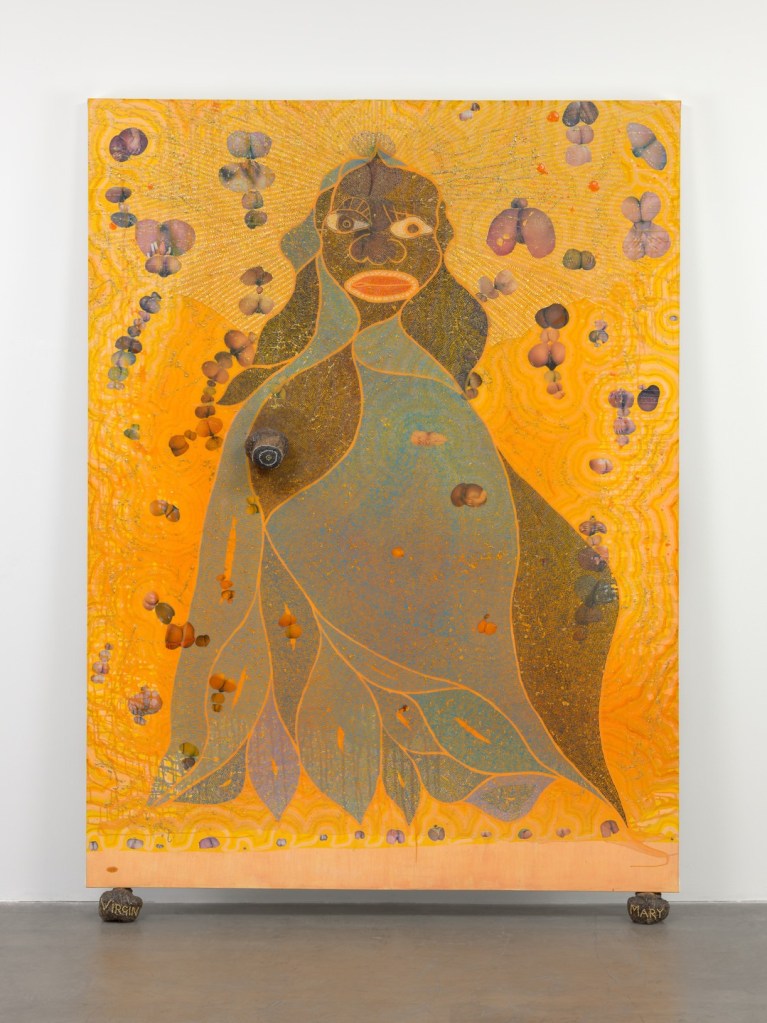
Chris Ofili, The Holy Virgin Mary (1996)
Maurizio Cattelan’s La Nona Ora (1999):
Maurizio Cattelan’s The Ninth Hour (translated from the Italian) is a hyper realistic life-sized wax figure that shows Pope John Paul II struck down by a meteorite. The pope lies on a red carpet with broken glass nearby, his body showing that he is in a state of pain, still clutching his papal cross. The meteorite, which looks heavy and dark, is embedded into his body, which makes escape quite impossible.
The title itself, “The Ninth Hour”, refers to the hour of Christ’s death on the cross (which was roughly around 3pm), as it was recounted in the Gospels. It is the final moment of human suffering, abandonment, and mortality. Cattelan draws a parallel between the death of Christ and the vulnerability of the pope, whose role is to “represent Christ’s love and concern for every single individual”. So, this piece confronts the fragility of even the most revered religious figures in this world. And even though the pope is meant to represent transcendence and divine connection, his mortal body can not withstand random and brutal fate, such as being hit by a meteorite… as cruel as that may sound, or in this case look!
Cattelan himself does not exactly give an explicit explanation, apart from the fact that he did not intend the piece as a direct attack on religion. Cattelan only describes his piece as a “three-dimensional image that dissolves into pure communication” and a reflection of life’s contradictions, such as prayer and profanity, faith and violence, peace and chaos, all living side by side.
I believe that the piece strongly resonates with Luhmann’s concept of immanence and transcendence. No matter how divine a figure may become in religious imagination, they remain bound to earthly vulnerability. And this does not only apply to mortality but also to emotional pain, political conflicts and injustice, or even social rejection or judgment. Just how Christ, in Christian theology, did not only die, but he also suffered emotional pain (abandonment by his followers), political injustice (condemned by worldly authorities), and physical agony (the crucifixion). Similarly, popes, saints, and other religious figures might face those kinds of human weaknesses that no religious status can fully erase. And in this piece the Pope becomes a symbol of that struggle. A revered figure brought low… not through sin, but through the randomness of earthly existence.
What I find particularly interesting, and funny even, is that, at first, Cattelan intended to depict the Pope standing with a crucifix, but when he finished that version, he believed that his piece lacked “the drama and the capacity to convey the feeling of being in front of something extraordinary and powerful”. This led him to make “a few changes”, as I would nicely put it, which turned out to make a more striking image of the fallen Pope struck by a meteorite. Scholar Melanie Holcomb even interpreted the sculpture as a kind of tribute to the Pope, noting how his body remains completely intact, still clutching the cross, which is miraculously undestroyed.
As the New York Times reports, the reaction in Poland shifted from initially being humorous to “grotesquely” serious. In December 2000, two Polish members of Parliament entered the Zacheta Gallery, Warsaw’s Museum of Contemporary Art, with the intention to physically remove the meteorite from the wax figure of the pope. They attempted to stand the figure upright and left a letter demanding the dismissal of the gallery’s director, Anda Rottenberg, accusing her of disrespect toward Catholic values. After becoming the target of hate mail and public attacks, accused both of anti-Catholicism and of being an outsider, Rottenberg, under pressure, decided to resign in March 2001. One has to imagine how chaotic, almost theatrical and absurd this scene became. Here once again, Cattelan’s message is reflected in the situation. His work acts like a mirror, showing society its contradictions and raw impulses. And the Polish controversy makes this message very clear. As I am writing this, the news just hit that Pope Francis died on April 21st, 2025. This once again proves the point of Cattelan’s La Nona Ora: no matter how sacred or powerful someone is, in the end, mortality catches up with everyone.
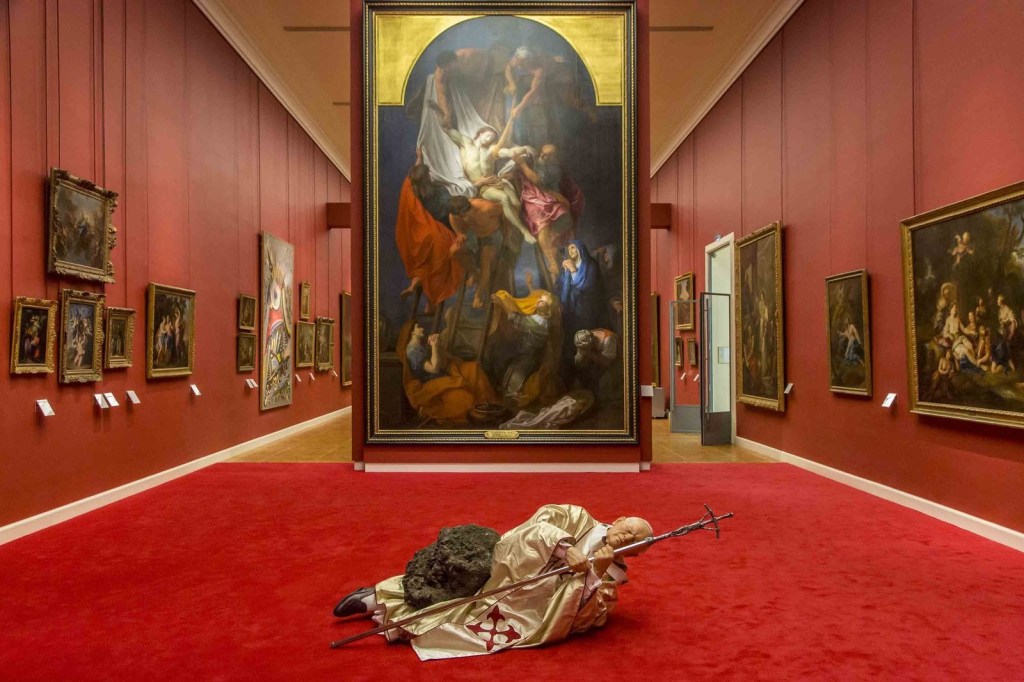
Maurizio Cattelan, La Nona Ora (1999)
2024 Paris Olympics Opening Ceremony:
We are now moving forward to a different kind of controversy, which can not be found in museums or galleries, but was actually on one of the biggest global stages: the Olympics.
One segment of the Paris 2024 Olympics opening ceremony showed performers sitting at a long table in a scene, which many found reminded them of Leonardo Da Vinci’s The Last Supper. The performers wore a mix of classical and “avant-garde-ish” (I say that as someone who does not have much knowledge of high fashion), and the setting further enhanced the sacred overtones.
According to Sky News, this image offended the viewers, particularly those from Christian groups. Even Italy’s Deputy Prime Minister Matteo Salvini called it “insulting” and “sleazy”. However, Paris 2024 officials insisted that the scene was definitely not intended to reference, or to be a parody of, The Last Supper, but rather a reference to the 17th-century Dutch painting of Olympian gods, The Feast of the Gods (1635-1640) by Jan van Bijlert. Personally, I find the organizers’ denial a bit unconvincing. The scene’s resemblance to The Last Supper is just way too striking to dismiss, and even if unintentional, a symbolic resonance with the Christian narrative was difficult to avoid and, in my opinion, even hard to oversee. However, the organizers did admit that they underestimated the risk of misinterpretation and later even revised parts of the closing ceremony script to avoid further offense.
Artistic director Thomas Jolly explained that the overall intention was “inclusion” and “celebration of diversity”, not religious provocation. Jolly also reported that he was faced by harassment and death threats following the backlash. He made a formal complaint which specifically cited “death threats on account of his origin, death threats on account of his sexual orientation, public insults on account of his origin, public insults on account of his sexual orientation”, “defamation” and “threatening and insulting messages criticizing his sexual orientation and his wrongly assumed Israeli origins” (The Athletic).
Another controversial moment in the opening ceremony involved a rider on a big metallic horse, who was galloping along the Seine River. The mechanic horse, covered in reflective metal plates, reminded many viewers on social media of the “pale horse” of Revelation, which symbolizes death and apocalypse. Accusations of blasphemy, and even satanism, were spreading quite rapidly on social media, even while the opening ceremony was shown live on television.
Reactions across France looked very differently to those outside the country. According to The Guardian, many French media outlets, like Le Monde, praised the ceremony, describing it as a “dreamlike spectacle”. Even President Emmanuel Macron applauded the creative team and Thomas Jolly for embodying French boldness and artistic freedom.
In contrast, far-right politicians and conservative Catholics saw the ceremony as “woke propaganda” and an “attack on Christianity”. Such criticism focused very heavily on elements such as the appearances of drag queens and multicultural imagery.
These case studies really show how blasphemy in (contemporary) art is never just about the artwork itself, but always about the connection between intention, perception and context. Whether it is a protest against political misuse of religion, a critique of commercialization of sacred symbols, a challenge to cultural norms, or a reflection on human vulnerability, each piece invites the viewer to reflect and open a dialogue. The reactions, whether they are emotional or political, show that religious imagery continues to remain important, even within supposedly secular societies.
Throughout all these examples, we can also see that the accusations of blasphemy often come from the viewer’s personality, belief and point of view, and from the environment the piece is set in. As Luhmann’s theory helps us understand, meaning is not fixed within the artwork, but can be found in different social systems. What one system sees as imaginative and creative, another might see it as deeply offensive and threatening.
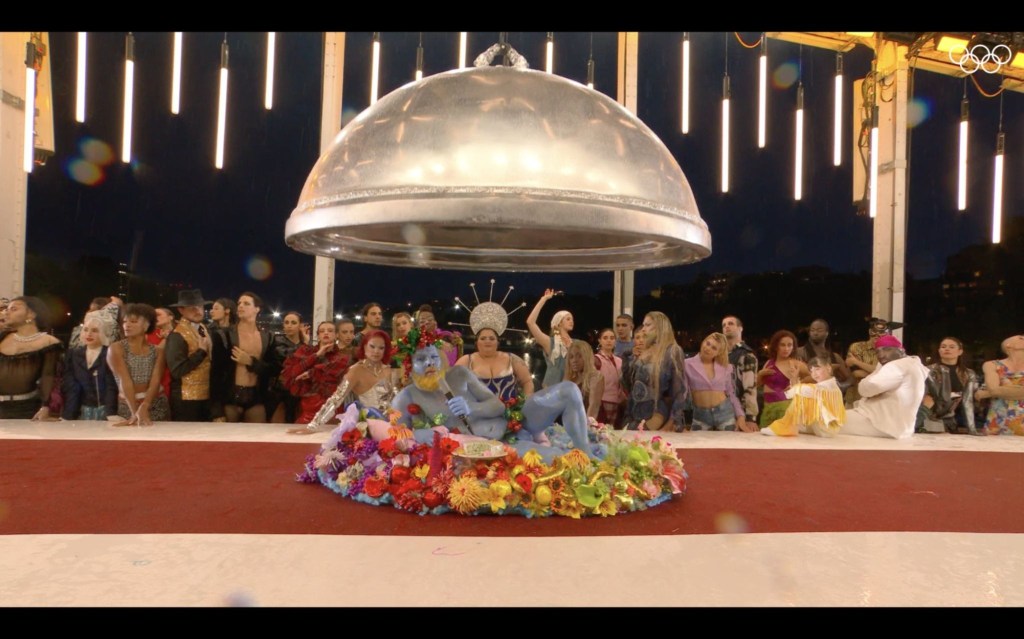
A tableau featuring drag queens, a transgender model, and dancers, Olympics Opening Ceremony Paris 2024
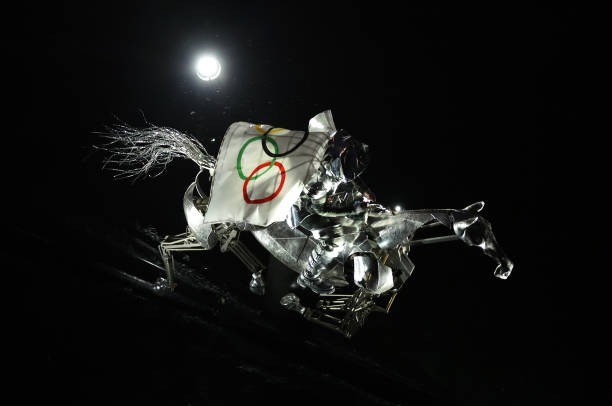
“Zeus, the mythical metal horse”, Paris 2024 Olympic Games Opening Ceremony
6. Ethics of Blasphemous Art
When we discuss the ethics of blasphemous art, we have to face an important main question: Should anything be allowed in art simply because it is art, or are there limits that should be respected when it comes to deeply held beliefs?
Culture changes over time, and I suppose we made that more than clear in the previous sections. Things that once used to cause huge scandals, are now seen as normal (with a few exceptions, of course). But the question still remains the same! If an artwork deliberately messes with religious ideas, and openly mocks them, should it automatically be allowed or even celebrated? On one side, there are people saying that art should most definitely stay free, even if it means that it raises uncomfortable, or even questionable topics, which makes it all the more interesting and welcome. Shouldn’t art have a (critical) message? On the other hand, some people argue that freedom of expression should have its limits and should in no case be used as an excuse to mock or attack others’ deeply personal beliefs. Just because you can do something does not mean you should!
Even if a religious belief and its ideologies seems extreme or strange to “outsiders”, for others, it is their, so to say, “anchor”. Without that anchor they could not make sense of the world, or even their own lives. For some it can simply be philosophy. And with philosophy being so very diverse, one can just pick a philosophical movement, even if it means that one is willing to follow the paths of nihilism, which just means that they would be rejecting any religious belief and adopt the doctrine that life is completely meaningless (sounds a lot easier to me than any religion). Mocking a religion can feel more like an attack, sometimes even quite personal, than a critique. This can even get much messier when you keep in mind that the best, and some would even argue the worst, parts of human history are tied to religion. This can go from having built beautiful communities to fuelling wars and oppression.
The Charlie Hebdo attack in 2015 is a chilling example for this problem. Cartoonists were killed simply for creating drawings, more specifically caricatures. Though I must say that caricatures do in general have a certain power of degradation to them, bringing out the most noticeable and striking features, whether it is physical or not. This attack forces one to ask the following question: If you do have the right to create anything you want, are you also ready to deal with the real-world consequences? Freedom of opinion and expression do exist, those are even fundamental human rights, but the news keeps reminding us that sometimes they come with horrifying risks.
Still, a lot of people defend the idea that art must be free. And it makes sense! If we only allow “nice” art, art that never challenges anyone, then we basically turn art into something pretty, but completely pointless (unless all you care about is beauty!).
Today, we are living in a world where practically everything can be called “problematic” and can be taken against people. That is where cancel culture and sensitivity reading (in literature) come in. In publishing, sensitivity readers are hired by publishers to go through books before they come out to the public, and make sure nothing might offend anyone. It can most definitely be useful, and it might even actually protect the author, but sometimes it can spiral out of control.
The Luxembourgish author Guy Rewenig makes fun of sensitivity reading in his recently published novel Bärenklau (2024). In his story, even innocent phrases get flagged as offensive. The satire shows how, if everything becomes offensive, pretty soon, nothing real can be said at all. This is important for blasphemous art too: If any artwork can be called “blasphemous” just because someone somewhere might get offended, are we slowly creating a world where no challenging art can exist?
This brings us to David Hume and his essay Of the Standard of Taste, a chapter in the third volume of Philosophical Works of David Hume (1852). While Hume admits that taste is subjective (meaning people like different kinds of things), he also believes that trained, experienced critics can offer much better judgments about art.
So, when someone feels offended by an artwork, that feeling is definitely real and valid, but it does not automatically mean that the artwork should be considered as bad or should be banned. Physically attacking and destroying it should also not be justified through personal emotions. Feeling is personal, and everybody feels and sees things a little differently.
However, Hume says something very important: even though everyone has their own taste, some judgments are better than others. Basically not every opinion about art carries the same weight. Experience, education, sensitivity, open-mindedness, and objectivity even matter in distinguishing which art matters and which does not. At first this definitely sounds like a great solution, but I, personally, believe that there is an issue.
If we only let experts decide, we risk making art cold and lifeless. Art’s beauty comes from all the different interpretations viewers may have, even if there are messy feelings involved. If art becomes a “professionals only” thing, where only professionals can determine if pieces should be shown or not, just the way sensitivity readers do it, then what exactly is the point of art?
Honestly, I think art can, and even should, be critical. It should definitely have the guts to challenge big topics, including religion. Because let’s face it, religion is sadly not always just about peace and love. Religion has sometimes been used to justify violence, inequality, and control. Ignoring that would be dishonest and unknowledgeable even.
But I truly believe that there are limits too. Or there should be at least! Some artists just seem like they are trying to be unique and edgy… did it really have to be a crucifix submerged in pee? Jokes aside, some pieces feel less like thoughtful critique and more like lazy shock tactics.
However, context is everything. For example, knowing that Andres Serrano (the artist behind Piss Christ) is actually a Christian changes the whole story to some extent. He was not mocking Christ, or Catholicism. He was criticizing how religious symbols get cheapened and commercialized. Without that background, the piece can seem just plain offensive.
This goes back to Luhmann’s system theory. Art and religion are two completely different languages. So, conflict is almost inevitable. But maybe conflict is not a bad thing. Maybe it is where growth happens.
At the end of the day, if a piece of art is genuinely trying to start a real dialogue, even a painful or an uncomfortable one, it deserves space. But if it is just mockery without any deeper message, then it becomes empty cruelty hiding behind the label of “freedom”.
The real challenge here is to find a balance. How do we make room for critical, meaningful art without falling into a world where nothing is allowed anymore. How do we keep both freedom and respect without having to let go of either one?
7. Conclusion
After going through all these different aspects (history, sociology, philosophy, theology, and a lot of case studies) it is pretty clear that the relationship between Christianity, art, and blasphemy is way more complicated than it might seem at first. Christianity once completely dominated art and decided how people lived, thought, and even imagined the world and afterlife. But today, things have changed by a lot. Blasphemous art does not lead to executions or exile anymore. Instead, it gets exhibited, awarded, and endlessly debated, even many years after its creation.
Thanks to Luhmann’s systems theory of religion, we can understand why that transition has happened. Religion is no longer the centre of everything, but is one system among many others. And as soon as religion loses its authority and control over every part of life, the rules around what is accepted automatically change alongside. Artists do not need to ask the Church for permission anymore. Art creates its own meaning and its own language now. Therefore, what used to be seen as blasphemy is now seen as a form of artistic expression or even critique (most of the time and by most people, at least).
However, even if society has become more secular, it is pretty obvious that religion still has a certain importance. People still get upset, angry, or in some cases even violent when those symbols are touched in the wrong way. So, if religion was really irrelevant, nobody would even care anymore. Yet, the fact that people still react so strongly shows that the sacred has not completely disappeared, and most probably will not for a very long time (perhaps never). In a way blasphemous art, even when it is offensive and provoking, ends up keeping religion alive by making people feel something.
When it comes to the ethical side of this issue, I believe that art should continue to be free. Yes, the Christian art, that was bound by rules, has so much history and meaning in it. And I might even consider most of the Christian artworks as some of the most beautiful pieces. But I do believe that without freedom, art would lose its meaning. However, I also think that freedom should come with some responsibility. Just because you can mock and humiliate something that many people build their lives around, does not always mean that you necessarily should. Critique is important, but mockery just for the sake of shock feels empty and useless. Context and intention matter so much. Knowing whether the artist is trying to start a dialogue, or just trying to be unique and edgy for attention, can completely change a piece’s meaning and how it should be judged.
And even though Hume would believe that experts should have more weight when it comes to judging blasphemous art, I think it is important to remember that art belongs to everyone, whether it is the artist creating it or the viewer absorbing it. If we take away all subjectivity and feeling, if only professionals are allowed to decide what is good or bad (or what is allowed and what is not), then art would lose its power to move people personally. Any kind of reaction is part of what makes art matter.
In the end, what this whole research showed me is that blasphemous art is not about insulting faith or trying to destroy it. Sometimes, it is about forcing people to step into dialogue, even if it is uncomfortable or painful. Sometimes, it is even about asking heavier questions that society might prefer to ignore. And yes, sometimes it can be a provocation without any real meaning. It is up to us viewers to look deeper and to judge carefully. It is all about point of view.
One thing is for sure: sacredness is not dead. It has just changed its place and how it works. It has to adapt to the ever changing world. Whether it is in churches, art galleries, or even on social media, the sacred still shows up, and it still matters to so many, perhaps even more than we think.
8. Bibliography
[1] Niklas Luhmann, A Systems Theory of Religion, Stanford University Press, 2013.
[2] The Holy Bible, Exodus 20:1–17 and Deuteronomy 5:4–21, in the second and fifth books of the Christian Old Testament.
[3] The Holy Bible, Leviticus 24:16 (King James Version): “And he that blasphemeth the name of the Lord, he shall surely be put to death, and all the congregation shall certainly stone him: as well the stranger, as he that is born in the land, when he blasphemeth the name of the Lord, shall be put to death.”
[4] Heresy, Cambridge Dictionary, https://dictionary.cambridge.org/dictionary/english/heresy (Last accessed April 10th, 2025).
[5] Index Librorum Prohibitorum (Index of Prohibited Books), first issued by the Roman Catholic Church in 1559 under Pope Paul IV.
[6] Tim S., Five Myths about the Spanish Inquisition, The Lexicon, 2025, https://thelexicon.org.uk/five-myths-about-the-spanish-inquisition-tim-s/ (Last accessed April 8th, 2025).
[7] Edward Lempinen, The Tortures of the Spanish Inquisition Hold Dark Lessons for Our Time, Berkeley News, July 20th, 2022, https://news.berkeley.edu/2022/07/20/the-tortures-of-the-spanish-inquisition-hold-dark-lessons-for-our-time/ (Last accessed April 8th, 2025).
[8] San Benito, The Concise Oxford Dictionary of the Christian Church, Oxford Reference, https://www.oxfordreference.com/display/10.1093/oi/authority.20110803100439809 (Last accessed April 10th, 2025).
[9] Father Brian Van Hove, Beyond the Myth of The Inquisition: Ours Is ‘The Golden Age’, reprint from Faith & Reason in Catholic Education Resource Center (CERC), 1992, https://catholiceducation.org/en/culture/beyond-the-myth-of-the-inquisition-ours-is-the-golden-age.html (Last accessed April 8th, 2025).
[10] End Blasphemy Laws campaign, https://end-blasphemy-laws.org/countries/ (Last accessed April 11th, 2025).
[11] 10 Key Bible Verses on the Second Coming of Christ, Crossway, 2024, https://www.crossway.org/articles/10-key-verses-on-the-second-coming-of-christ/ (Last accessed April 27th, 2025).
[12] Friedrich Nietzsche, The Gay Science (original title: Die Fröhliche Wissenschaft), 1882.
[13] Cathédrale Notre-Dame de Luxembourg, Luxembourg City Tourist Office, https://www.luxembourg-city.com/fr/adresse/church/cathedrale-notre-dame (Last accessed April 12th, 2025).
[14] Simcha Fisher, Are There Rules for ‘Religious Art’?, National Catholic Register, 2013, https://www.ncregister.com/blog/are-there-rules-for-religious-art (Last accessed April 12th, 2025).
[15] Sebastian Schütze, Caravaggio – Das vollständige Werk, Taschen Verlag, 2009, 144, 146, 148, 150, 369–370.
[16] The Holy Bible, Genesis 2:5–7 (King James Version): “5 And every plant of the field before it was in the earth, and every herb of the field before it grew: for the Lord God had not caused it to rain upon the earth, and there was not a man to till the ground. 6 But there went up a mist from the earth, and watered the whole face of the ground. 7 And the Lord God formed man of the dust of the ground, and breathed into his nostrils the breath of life; and man became a living soul.”
[17] Frank Zöllner, Michelangelo – Das vollständige Werk, Taschen Verlag, 2014), 205–211, 663–670.
[18] Frank Zöllner, Leonardo, Taschen Verlag, 2015.
[19] Hayward Gladwin, The Secret and Sacred Geometry of Leonardo da Vinci’s The Last Supper, Mysterious Writings, 2017, https://mysteriouswritings.com/the-secret-and-sacred-geometry-of-leonardos-the-last-supper-by-hayward-gladwin/ (Last accessed April 17th, 2025).
[20] Fyodor Dostoevsky, The Idiot, Bantam Classic, 1869, Part Two, Chapter 4; 2005 edition, p. 245.
[21] Steven Stowell, The Last Judgment – fresco by Michelangelo, Britannica, 2023, https://www.britannica.com/topic/The-Last-Judgment (Last accessed April 22nd, 2025).
[22] Elise Chagas, León Ferrari – Argentine (1920–2013), Museum of Modern Art (MoMA), 2023, https://www.moma.org/artists/1859-leon-ferrari#fn:1 (Last accessed April 22nd, 2025).
[23] The Holy Bible, Matthew 22:39 (King James Version): “And the second is like unto it, Thou shalt love thy neighbour as thyself.”
[24] Angelique Chrisafis, Attack on ‘blasphemous’ artwork fires debate on role of religion in France, The Guardian, 2011, https://www.theguardian.com/world/2011/apr/18/andres-serrano-piss-christ-destroyed-christian-protesters (Last accessed April 8th, 2025).
[25] Vincent Noce, Andres Serrano: ‘I have no sympathy for blasphemy’, Libération, 2011, https://www.liberation.fr/arts/2011/04/19/andres-serrano-i-have-no-sympathy-for-blasphemy_730482/ (Last accessed April 23rd, 2025).
[26] Carol Vogel, Holding Fast to His Inspiration; An Artist Tries to Keep His Cool in the Face of Angry Criticism, The New York Times, 1999, https://www.nytimes.com/1999/09/28/arts/holding-fast-his-inspiration-artist-tries-keep-his-cool-face-angry-criticism.html?camp=7JFJX (Last accessed April 21st, 2025).
[27] The Holy Bible, Matthew 27:46 (King James Version): “And about the ninth hour Jesus cried with a loud voice, saying, Eli, Eli, lama sabachthani? That is to say, My God, my God, why hast thou forsaken me?”
[28] The Pope’s Role in the Catholic Church, Wijngaards Institute for Catholic Research, https://www.churchauthority.org/blueprint/pope.asp#:~:text=The%20Pope’s%20Role%20in%20the,concern%20for%20every%20single%20individual (Last accessed April 26th, 2025).
[29] Alicia Bona, excerpt from Everybody Must Get Stoned in La Nona Ora (The Ninth Hour) (1999), fARTiculate, 2010, https://farticulate.wordpress.com/2010/10/21/la-nona-ora-the-ninth-hour-1999/ (Last accessed April 26th, 2025).
[30] Andrea Bellini, Un Intervista con Maurizio Cattelan, Sculpture Magazine, 2005, https://sculpturemagazine.art/un-intervista-con-maurizio-cattelan/ (Last accessed April 26th, 2025).
[31] Scott Indrisek, Revisiting Maurizio Cattelan’s Sculpture of the Pope Struck by a Meteorite, Artsy, 2019, https://www.artsy.net/article/artsy-editorial-revisiting-maurizio-cattelans-sculpture-pope-struck-meteorite (Last accessed April 26th, 2025).
[32] Apollinaire Scherr, ART/ARCHITECTURE; A Fallen Pope Provokes a Sensation in Poland, The New York Times, 2001, https://www.nytimes.com/2001/05/13/arts/art-architecture-a-fallen-pope-provokes-a-sensation-in-poland.html (Last accessed April 27th, 2025).
[33] Rob Harris, Paris 2024 Olympics: Organisers Respond to Offended Reactions to Opening Ceremony, Sky News, 2024, https://news.sky.com/story/paris-2024-olympics-organisers-respond-to-offended-reactions-to-opening-ceremony-13185771 (Last accessed April 27th, 2025).
[34] Ben Burrow and Brendan Quinn, Paris Mayor Supports Olympics Opening Ceremony Director After Death Threats, The Athletic by The New York Times, 2024, https://www.nytimes.com/athletic/5676626/2024/08/02/paris-olympics-opening-ceremony-criticism/?searchResultPosition=1 (Last accessed April 27th, 2025).
[35] The Holy Bible, Revelation 6:8 (King James Version): “And I looked, and behold a pale horse: and his name that sat on him was Death, and Hell followed with him. And power was given unto them over the fourth part of the earth, to kill with sword, and with hunger, and with death, and with the beasts of the earth.”
[36] Bhavika Rathore, ‘Pale Horse of Death’: Netizens Call Metal Horse at Paris Opening Ceremony ‘Ominous’, The Hindustan Times, 2024, https://www.hindustantimes.com/world-news/us-news/pale-horse-of-death-netizens-call-metal-horse-at-paris-opening-ceremony-ominous-101722066832084.html (Last accessed April 27th, 2025).
[37] Jon Henley, ‘It Was Like Us – a Chaotic Mess’: France Enjoys Paris Games Opening Ceremony, The Guardian, 2024, https://www.theguardian.com/world/article/2024/jul/27/france-verdict-paris-olympic-opening-ceremony (Last accessed April 27th, 2025).
[38] David Hume, The Philosophical Works of David Hume, Cambridge, Allen and Farnham Printers, 1852, vol. 3, Essay XXIII, p. 252: “Beauty is no quality in things themselves: It exists merely in the mind which contemplates them; and each mind perceives a different beauty.”
[39] David Hume, The Philosophical Works of David Hume, Cambridge, Allen and Farnham Printers, 1852, vol. 3, Essay XXIII, p. 265: “Under some or other of these imperfections, the generality of men labour; and hence a true judge in the finer arts is observed, even during the most polished ages, to be so rare a character; Strong sense, united to delicate sentiment, improved by practice, perfected by comparison, and cleared of all prejudice, can alone entitle critics to this valuable character; and the joint verdict of such, wherever they are to be found, is the true standard of taste and beauty.”
Online Image sources:
“Olympic Games Post.” X (formerly Twitter). Last accessed April 27, 2025. https://x.com/Olympics/status/1816929100532945380.
“The Conversion of Saint Paul by Caravaggio.” Caravaggio.org. Last accessed April 27, 2025. https://www.caravaggio.org/conversion-of-saint-paul.jsp.
“Abendmahlsdarstellungen in der Kunst.” katholisch.de. Last accessed April 27, 2025. https://www.katholisch.de/artikel/43885-abendmahlsdarstellungen-in-der-kunst.
“The Body of the Dead Christ in the Tomb, by Hans Holbein the Younger.” Wikimedia Commons. Last accessed April 27, 2025. https://commons.wikimedia.org/wiki/File:The_Body_of_the_Dead_Christ_in_the_Tomb,_and_a_detail,_by_Hans_Holbein_the_Younger.jpg.
“Instalaciones.” Leon Ferrari Official Website. Last accessed April 27, 2025. https://leonferrari.com.ar/instalaciones/.
“Immersions Series by Andres Serrano.” Andres Serrano Official Website. Last accessed April 27, 2025. https://andresserrano.org/series/immersions.
“Chris Ofili, The Holy Virgin Mary.” The Museum of Modern Art (MoMA). Last accessed April 27, 2025. https://www.moma.org/collection/works/283373.
“La Nona Ora by Maurizio Cattelan.” Perrotin Gallery. Last accessed April 27, 2025. https://www.perrotin.com/artists/Maurizio_Cattelan/2/la-nona-ora/15420.
“Olympic Opening Ceremony Photos.” Getty Images. Last accessed April 27, 2025. https://www.gettyimages.com/photos/olympic-opening-ceremony.
 Evelyne's Thoughts
